


On November 25, 2025, Tony Han, Founder and CEO of WeRide, appeared on CNBC's Squawk Asia, he discussed WeRide's strong Q3 2025 earnings and shared insights into the company’s bold global expansion plan and profitability vision.
The following is the full transcript of the interview.
Mandy Drury, CNBC
Tony Han is the CEO of WeRide. He joins us now alongside our China reporter, Elaine Yu, who's also joining the conversation. Tony, great of you to join us today. Welcome to CNBC. I guess I'm going to ask the question that's on everybody's lips, and that is, when do you think you're going to be profitable?
Dr. Tony Han, WeRide
A very good question. First of all, I think the profitable phase is for sure coming. If we look at our Q3 numbers, there are several numbers I can share with you. Actually, we had one of the largest quarterly revenue increases. We increased 140% compared to last year, and compared to the last quarter, we also increased 34% with a very good profit margin of 32.9%. And you can see that our research expenditure is growing, but in terms of profit margin, in terms of revenue, and in terms of market, it's growing faster.
So if you have two function curves, one growing but with a very flat slope, the other growing exponentially, you can be sure that these two curves will intersect in the future. But we still need to wait for more time to check our hypothesis. But I think the sure thing is this company will be profitable when you look at our numbers. And a few more numbers I want to share with you: last quarter, we had a revenue of 171 million RMB, and we acquired the first city-level driverless operation permit in Abu Dhabi. This is the first of its kind outside the U.S. And everybody now in Abu Dhabi, if you have an Uber app, you can hail a driverless robotaxi in Abu Dhabi, just like what you can do in San Francisco and Los Angeles. So this is kind of a historical moment. It is just like if you say, when do you think Waymo will be profitable? Like if you asked 10 years ago, when will Tesla be profitable? You know, I'm not very, very concerned about the exact timing, but I'm pretty sure of the result. I'm very optimistic with WeRide's leading position in the global market and our technology. Profitability is a sure thing.
Mandy Drury, CNBC
Indeed, so not just the license approval in Abu Dhabi that you're speaking of, Tony, you've also recently got approvals in places like Switzerland on top of Singapore and Saudi Arabia and Belgium and others. Now you're in eight countries around the world, or at least you've got licenses to operate there. Where is the next frontier? What country is next in your sights?
Dr. Tony Han, WeRide
Okay, so that's again a very good question. Thanks for the question. You know, before this interview, I tried to memorize these eight countries. It's getting harder and harder to memorize these eight countries, but the trick is: four in Asia, that is Saudi, UAE, Singapore, and China, and three in Europe, that is Belgium, France, and Switzerland, and then there's US. Which country will be the ninth, I'm not sure. We are trying to explore all possibilities. Japan is a possibility, and some countries like Norway and Spain are also possibilities. Malaysia as well. It all depends on having very strong local collaborators, the availability of strong local collaborators, and also regulatory support. So these are the factors. It's kind of hard to give exact numbers, but we are sure the promising markets are in Europe, Asia, East Asia, Middle East, and also MENA countries. Those are all potential countries for our ninth driverless permit.
Elaine Yu, CNBC
And Tony, great to see you again. So you mentioned a range of different countries, those in Europe, in the Middle East, China, potentially Japan. And we're looking at a lot of very different environments, climates here. And I'm also seeing a very quick expansion across all these countries. So how do you ensure safety and how do you scale this tech, when you look at so many different markets and so many different climates?
Dr. Tony Han, WeRide
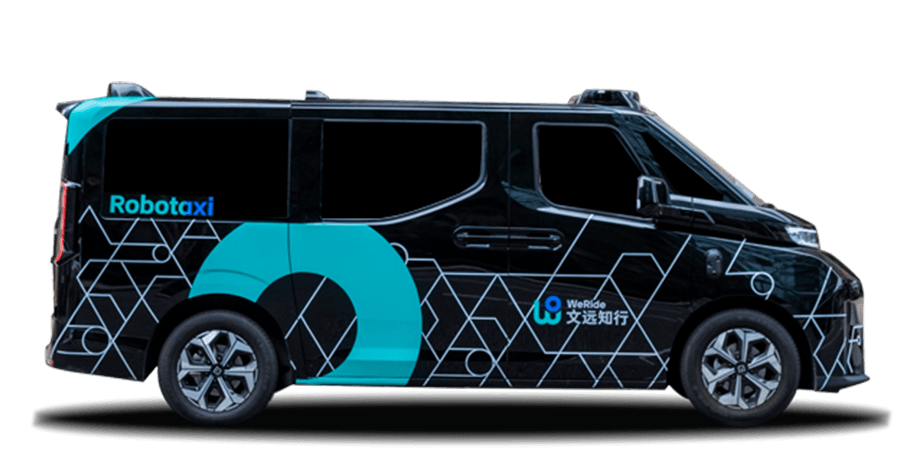
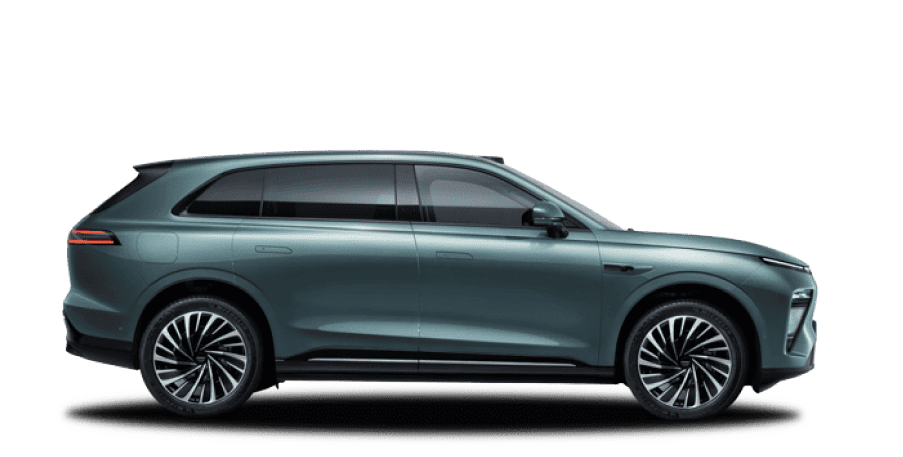
Again, thanks a lot for this fantastic question. About scalability, I think WeRide is the only autonomous driving company in the world taking both Tesla's approach and Waymo's approach. For Waymo's approach, we use Level-4 robotaxis with HD maps and with traditional machine learning frameworks, enhanced by recent large language models. We have already put this into real operation in Abu Dhabi, Beijing, and Guangzhou, and soon in Dubai and Riyadh. You can actually hail a driverless robotaxi through either the Uber or WeRide Go app. So for that part, we have already done things that are very similar to what Waymo has done. And for Tesla's approach, WeRide just rolled out WePilot 3.0, which is comparable to FSD 14 of Tesla, and our ADAS system has already been installed in several of Chery's mass production passenger cars, like Chery Exeed ET and Chery Exeed ES, and soon it will be installed in Guangzhou Automobile Group's Aion car. So there is wide adoption of our ADAS system. Leveraging on these two different approaches: the ADAS-based approach is navigation map-based, huge and intensive machine learning model-based. It has very good generality, but for reliability, I think the traditional robotaxi Level-4 approach is unparallelled. We managed to find a marriage of these two methods and leverage on two heterogeneous data from different sources. So, I think we can maintain generality while, at the same time, keep redundancy, and have a very good safety record based on our Waymo-like robotaxi operations. So far, we have been operating for 2,200 days, and our safety record is very, very good.
Elaine Yu, CNBC
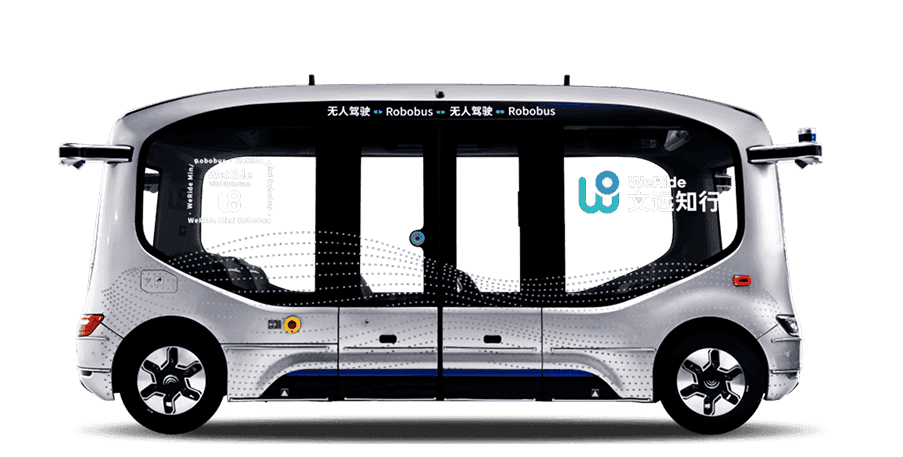
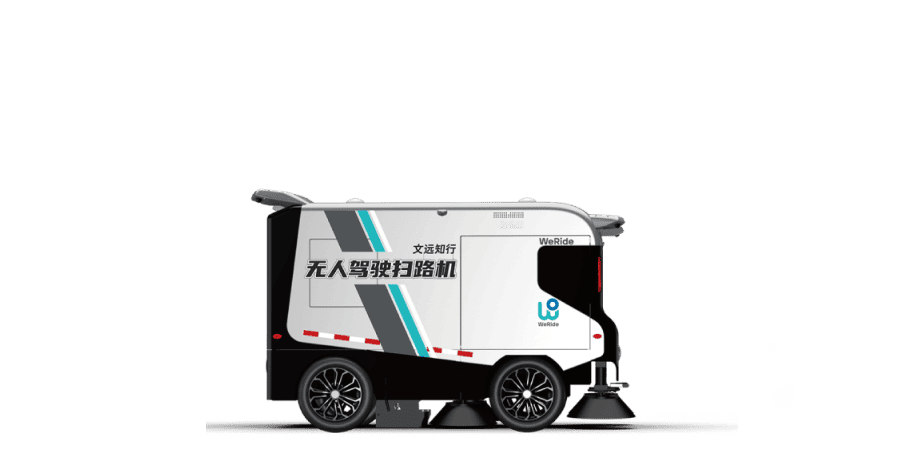
And also, in terms of the vehicles that WeRide is involved in, there are robotaxis, robosweepers, robobuses. Why go into all these different vehicle types? What's the strategy behind that?
Dr. Tony Han, WeRide
Yeah, the strategy is simply a platform strategy. It's like a Linux-based operating system that can support a PDA, pad, laptop, supercomputer, and smartphone. So, I think WeRide is building a very generic autonomous driving operating system which can support robotaxis, ADAS systems, robobus, and even robosweepers. If you think about this problem in principle, they are all vehicles running in urban scenarios. They have to auto-detect cyclists, jaywalkers, recognize signal lights, and try to very conservatively avoid other people violating traffic rules. All of these scenarios have to be solved, no matter the application. So we thought about it deeply and said okay, let's create a kind of machine learning-based platform that can solve all these scenarios all over the world, not only just in one country. And then once we've done this, we do it once, and it works for all applications. This way, we can reuse all algorithms and hardware design to the fullest extent. That is also one of our major competitive edges. In comparison with our competitors, I think we are unique in reusing algorithms. We have a very strong supply chain because all these products share the same hardware model, and all the designs are modularized. So this gives us a very good advantage.
Elaine Yu, CNBC
And looking at your latest quarterly numbers, the company is not profitable yet, but we've seen that loss narrowing and also revenues being driven by what the company has said are things like intelligent data services and autonomous driving related operations. Can you share a bit more color on what these intelligent data services or operations are that are driving revenue?
Dr. Tony Han, WeRide
OK, so there are many robotaxi services, of course, with certain data annotation and also tool supply needs. We have our collaborators, and they sometimes need data annotation and all the tools, and we actually want to try to find all the opportunities for forming certain alliances. At the same time, if they like our relevant data services or tool services, we are very open to sharing with them. Of course, with certain commercial and profit margin. But the main thing is the robotaxi. I just want to emphasize our product revenue and robotaxi service-related revenue grew 428% and 66% year-to-year in the third quarter of 2025. Robotaxi revenue grew 7 times year-to-year. So all of these numbers show both product revenue and service revenue are very strong. I basically let product revenue and service revenue run freely. So, as long as we maintain our competitive edge, as long as we continue to extend our global market, you know, I don't want to add constraints. Whichever category can sell more with a certain profit margin, I would just say go freely.
Elaine Yu, CNBC
Tony, you talk about the competitive edge, which of course is a nod to the fact that this is increasingly becoming a highly competitive sector. Do you see any M&A activity on the cards for your company in the next few years?
Dr. Tony Han, WeRide
I think we are leaving this issue to be open. There are always very outstanding startups, and if they have their unique technology and we have enough cash reserved in our bank, I won't shut the door. And if there's a good startup, we can acquire them. Also, if we want to acquire a startup for the purpose of talent acquisition, I have never refrained from doing that, because talent does not grow on trees. Sometimes you meet them once in your life., and you better seize the chance to acquire them. In terms of forming a partnership, we are very strong. We formed partnerships with Uber, Grab, Bosch, Guangzhou Automobile Group, Chery, and many, many more strong partners. And in the future, if we want to form a certain form of JV, or form a JV for the global market, we are very open to doing so.
Mandy Drury, CNBC
So who do you see then as your biggest competitor right now, Tony? And in the same way that here in Australia, in the rideshare market, fierce competitors Uber and Didi, from a consumer standpoint, I toggle between the two of them depending on who's offering me the best price at the time. So what do you think that you would offer a consumer that would make them choose you over a competitor?
Dr. Tony Han, WeRide
Okay, I think, as I mentioned in other occasions, our major competitor is really about who can provide better service to our customers at a reasonable cost. WeRide will never compete for lower prices. We want to compete for higher quality with an acceptable price range. I just visited Sydney two months ago for a forum and I saw huge potential in the Australian market. And so to us, we've been considering three factors. Number one, how can we keep our advantage and leading position in technology? Number two, how can we keep on improving the quality of service to satisfy our customers? Number three, how can we build up strong alliances, partnerships, with local government, and with local partners? These are three major factors we are considering. If we can handle all of these three categories very well, we can keep our current leading position for sure. So in terms of competition, it has always been very intensive since 2017 when we founded this company. At that time, there were hundreds of startups, but most of them have already died off. WeRide is remaining in the leading position, and we are confident of keeping this position.
Mandy Drury, CNBC
Well, you're obviously exploring the Australian market, Tony. When are you coming here? As in, when are you likely to operate here?
Dr. Tony Han, WeRide
Actually, I received several invitations. Frankly speaking, I'm studying Australia's policy very carefully, and have several meetings scheduled with local governments. And in the Sydney and Melbourne areas, we've actually started, and I think Uber has been adopted quite widely here. Uber is a very good partner for us, so we will explore that for sure. Also, Australia is a right-hand-drive country, and we have already designed our robotaxis for right-hand-drive countries, for example Japan, some regions in Hong Kong, and Singapore. In Singapore, we have already had this kind of robotaxi ready. So once the policy is available and when we find strong local partners, I think our technology and products are ready to be extended to the Australian market.
Mandy Drury, CNBC
We look forward to hearing more. Thank you so much for joining us today. It's been a pleasure, Tony Han of WeRide.